
Steel Pipe Weight Calculator
Steel pipe is sold by weight, not by length — so before you compare two quotations, convert both to a rate per kilogram. Enter the outside diameter, wall thickness and length below to get weight per metre, weight per pipe and total tonnage.
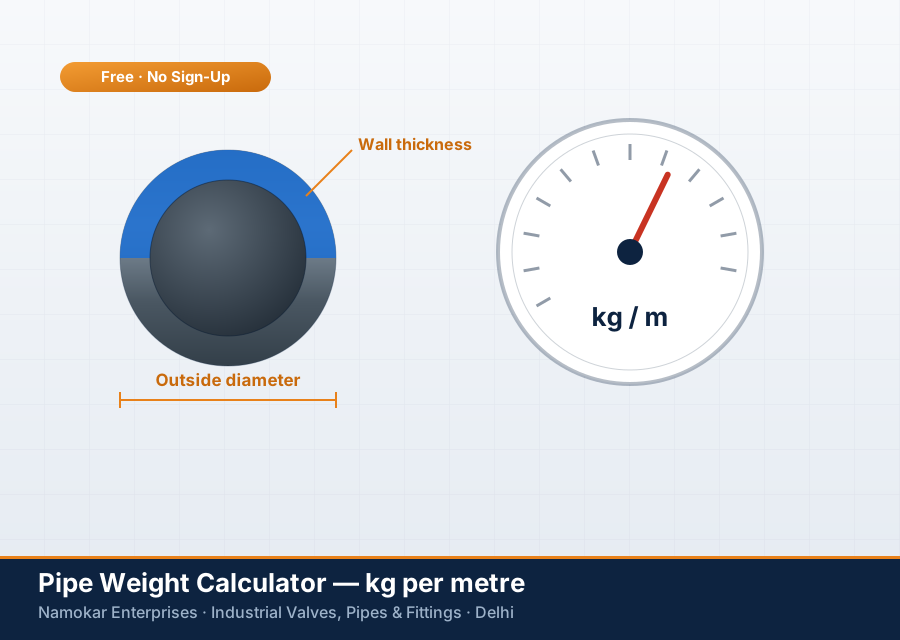
Round pipe (MS, GI, SS, seamless)
Common outside diameters (IS 1239)
| Nominal | NB | Outside dia (mm) | Thickness A / B / C (mm) |
|---|---|---|---|
| ½" | 15 mm | 21.3 | 2.0 / 2.6 / 3.2 |
| ¾" | 20 mm | 26.9 | 2.3 / 2.6 / 3.2 |
| 1" | 25 mm | 33.7 | 2.6 / 3.2 / 4.0 |
| 1¼" | 32 mm | 42.4 | 2.6 / 3.2 / 4.0 |
| 1½" | 40 mm | 48.3 | 2.9 / 3.2 / 4.0 |
| 2" | 50 mm | 60.3 | 2.9 / 3.6 / 4.5 |
| 2½" | 65 mm | 76.1 | 3.2 / 3.6 / 4.5 |
| 3" | 80 mm | 88.9 | 3.2 / 4.0 / 4.8 |
| 4" | 100 mm | 114.3 | 3.6 / 4.5 / 5.4 |
| 5" | 125 mm | 139.7 | 4.5 / 4.8 / 5.4 |
| 6" | 150 mm | 165.1 | 4.5 / 4.8 / 5.4 |
Square & rectangular hollow section
Need a price against this weight?
Send us the calculated tonnage with size and class and we will quote a rate per kg the same working day.
💬 WhatsApp your quantitiesHow the calculation works
For a round pipe, weight in kilograms per metre is:
W = π × (OD − t) × t × ρ ÷ 1000
where OD is the outside diameter in millimetres, t is the wall thickness in millimetres, and ρ is density in grams per cubic centimetre — 7.85 for mild and carbon steel, 7.93 for stainless steel 304 and 316. Galvanising adds roughly four to six percent; the calculator uses five percent, which is the usual trade convention.
For a square or rectangular hollow section:
W = ((2 × t × (A + B)) − (6.575 × t²)) × 7.85 ÷ 1000
where A and B are the two side dimensions and t the wall thickness, all in millimetres. The 6.575 factor corrects for the rounded corners that IS 4923 sections actually have — an outer radius of twice the wall thickness and an inner radius equal to it. Simpler sharp-cornered formulae you will find online overstate section weight by roughly three percent, which on a twenty-tonne fabrication order is not a rounding error. Our figures match the section weight tables published by the mills.
These are the standard theoretical formulae. Actual mill weight varies within the tolerance the relevant standard permits — typically ±10% on individual pipes under IS 1239, tightening on a consignment basis. Invoicing is against actual weighed weight, so treat the calculated figure as an accurate estimate for comparison and budgeting rather than an exact invoice value.
Pipe weight — common questions
Why is steel pipe sold by weight and not by length?
Does the calculator account for the socket on screwed pipes?
How accurate is the galvanising allowance?
Need a price today?
Send us your BOQ, drawing or item list on WhatsApp and get a written quotation the same working day. Ready stock for most sizes at our Delhi godown.