Flange Identification Tool
Ordering a mating flange for an existing joint means matching the standard exactly — a Table E flange will not bolt to an ASA 150 flange. Pick the standard and size below to get the outside diameter, bolt circle, hole count and bolt size, then check them against the flange in front of you.
Still not sure?
Send a photo of the flange on WhatsApp with the outside diameter, bolt circle and hole count written on it. We identify these several times a week and will tell you exactly what to order.
💬 Send a photoWhat to measure
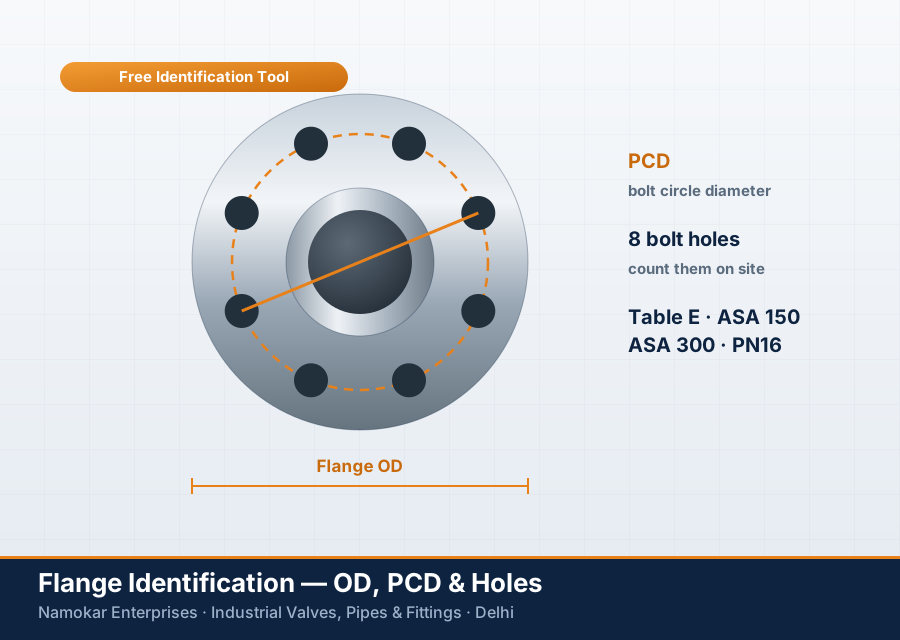
- Flange outside diameter — the overall diameter of the disc, edge to edge.
- Bolt circle diameter (PCD) — the distance from the centre of one hole to the centre of the hole directly opposite. On flanges with an odd arrangement, measure from the centre of one hole to the far edge of the opposite hole and subtract half the hole diameter.
- Number of bolt holes — count them; 4, 8, 12 and 16 are the usual figures.
- Bore — the internal diameter, which tells you the pipe size it fits.
- Facing — is the gasket surface completely flat (FF) or does it have a raised ring around the bore (RF)?
Flange types we supply
Slip-on (SORF), weld neck (WNRF), blind, screwed, socket weld, lap joint, plate and puddle flanges, in carbon steel A105, SS 304/316, cast iron and ductile iron. IBR certified flanges available for steam service. See our flanges page for the full range, or ask for gaskets and fastener sets to match.
Flange questions we get asked
How do I identify an unmarked flange on site?
Will a Table E flange bolt onto an ASA 150 flange?
What is the difference between flat face and raised face?
Need a price today?
Send us your BOQ, drawing or item list on WhatsApp and get a written quotation the same working day. Ready stock for most sizes at our Delhi godown.